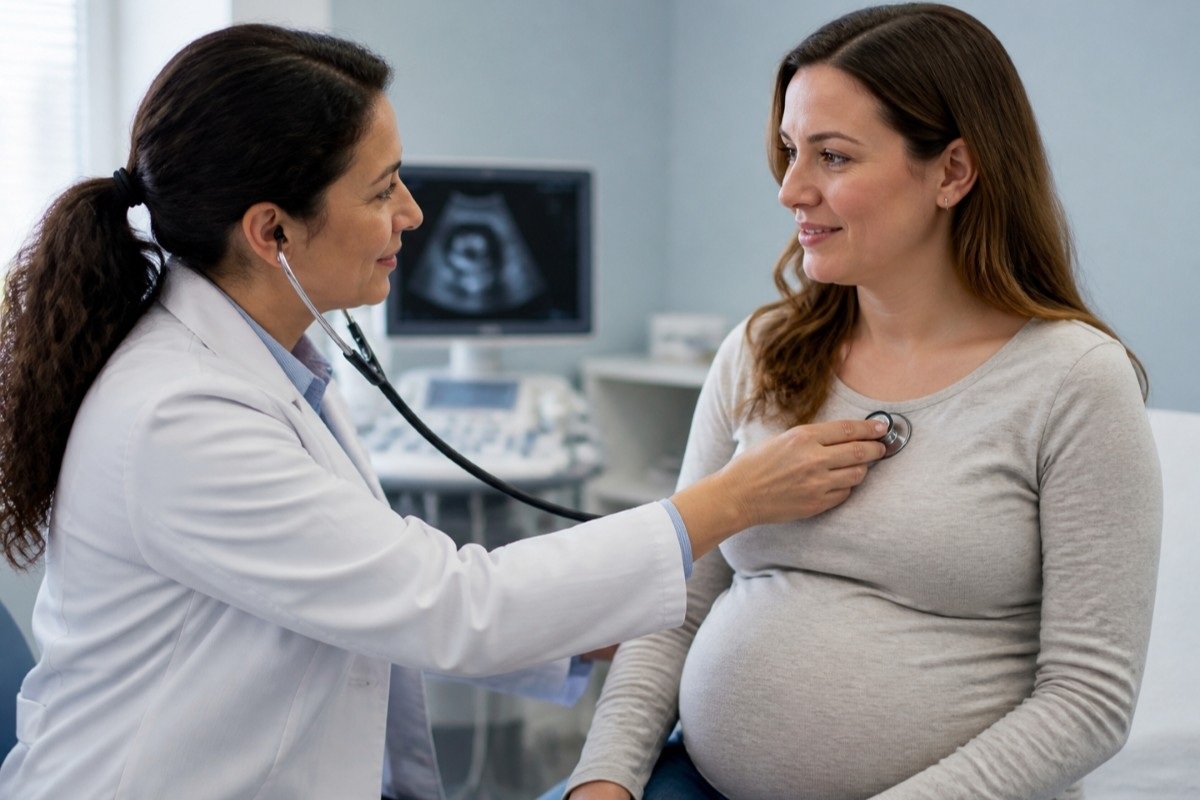
Pregnancy asks more of your cardiovascular system than it will at almost any other time in your life. Your blood volume rises sharply to supply the placenta, your heart pumps more blood with every beat, and your blood vessels relax to keep pressure steady. Those changes begin in the first trimester and peak in the middle of the second. Most healthy hearts adapt without trouble. But the same shifts can unmask a heart problem that was quiet before pregnancy, or make an existing one harder to manage.
Is a higher resting heart rate normal in pregnancy?
Yes. A resting heart rate that climbs by roughly 10 to 20 beats per minute is one of the most predictable changes of pregnancy. If your baseline resting heart rate sat in the 60s, seeing your heart rate in the 80s on a fitness tracker is expected rather than alarming. The rise builds gradually and stays with you until after delivery.
How it behaves matters more than the number. A rate that jumps suddenly, stays high while you are sitting still, or comes with lightheadedness is worth reporting.
Are heart palpitations normal during pregnancy?
Brief flutters, skipped beats, or a pounding sensation when you stand up quickly are common and usually harmless. They show up more in the second half of pregnancy, when your heart is working hardest, and often worsen with caffeine, dehydration, anemia, or an overactive thyroid. Those last two are treatable causes worth checking. Call your provider if palpitations last more than a few minutes, come with chest pain or fainting, or wake you from sleep.
What chest pain during pregnancy can mean
Most chest discomfort in pregnancy is not the heart. Reflux leads the list, since pregnancy hormones relax the valve at the top of the stomach while a growing uterus pushes upward. Rib and muscle strain from a shifting ribcage comes second.
Chest pain still deserves same-day attention when it feels like pressure, spreads to your jaw, neck, or arm, comes with sweating or nausea, or arrives alongside sudden shortness of breath. Pregnancy raises your risk of blood clots, and a clot in the lung can present exactly this way.
When should swelling during pregnancy be a concern?
Gradual swelling in your feet and ankles that worsens through the day and improves overnight is ordinary, especially in the third trimester. Concerning swelling looks different:
- Sudden puffiness in your face, around your eyes, or in your hands
- Swelling paired with a bad headache, vision changes, or upper abdominal pain
- Swelling in one calf only, particularly with pain, warmth, or redness
- Swelling with shortness of breath when you lie flat
The first two patterns point toward preeclampsia. The third suggests a clot. The fourth can mean fluid is backing up because your heart is not keeping pace.
Can pregnancy lead to heart failure?
It is uncommon, but yes. Peripartum cardiomyopathy is a weakening of the heart muscle that develops in the final weeks of pregnancy or in the months after delivery. Its early signs, including fatigue, swelling, and breathlessness, overlap so heavily with ordinary late pregnancy and newborn exhaustion that it is often caught late. Trouble breathing while lying flat, waking at night short of air, or a persistent cough is the pattern that separates heart failure from normal tiredness.
Women who enter pregnancy with chronic high blood pressure, a known valve problem, or a prior cardiomyopathy can benefit from a plan built before conception rather than after a symptom appears.
Why is a fetal echo done?
A fetal echocardiogram is a detailed ultrasound of your baby’s heart, usually performed between 18 and 24 weeks. It goes well beyond the heart views included in a standard anatomy scan. It is typically recommended when there is a family history of congenital heart disease, when the mother has diabetes or an autoimmune condition, after certain medication exposures, or when a routine scan raises a question.
Finding a heart issue before birth does not change the diagnosis, but it changes preparation, including where and how delivery is planned.
Building a heart plan that outlasts your pregnancy
Cardiovascular changes are not only a nine-month story. High blood pressure or preeclampsia during pregnancy raises your long-term risk of heart disease, which makes what happens now worth documenting and carrying into your care for the rest of your life. Current guidance leans toward treating these events as lasting cardiovascular information rather than something that ends at delivery.
The maternal-fetal medicine team at the High Risk Pregnancy Center provides fetal echocardiography, advanced ultrasound, and care coordinated with your OB/GYN in Las Vegas, Henderson, and Reno. If you have a heart condition, a history of preeclampsia, or symptoms that do not feel right, schedule an appointment with the High Risk Pregnancy Center by calling 702-382-3200.